Monday - Thursday 9AM - 5PM | Friday 9AM - 4PM
How to Build a Reliable Sensor Based Measurement Solution for Your Industry

A field-engineer’s guide to sensors, signal conditioning, data logging and calibration working as one system.
I’ve walked onto more than one site where the client had bought a genuinely good sensor and still couldn’t trust the number on their screen. The sensor was never the problem. What was missing was everything wrapped around it: the signal conditioning, the logging, the calibration schedule, the way the whole system talked to itself. A sensor is only one part of a measurement solution. If you’re researching how to reliably measure flow, pressure, load, tilt, vibration or temperature in your industry, it pays to understand the full system before you buy anything.
This guide walks through how sensors, signal conditioning, data loggers and calibration combine into one reliable sensor-based measurement solution, and what to look for whether you’re specifying a system for rail, structural monitoring, environmental research, mining or general industrial use.
What Is a Sensor-Based Measurement Solution?
A sensor-based measurement solution is the full chain of equipment and process that turns a physical event, a load shifting, a temperature rising, a structure flexing under wind load, into data you can actually act on. It isn’t one product sitting on a shelf. In practice it’s four parts working together:
- A sensor that detects the physical parameter — load, pressure, position, tilt, vibration, temperature, flow, strain or speed
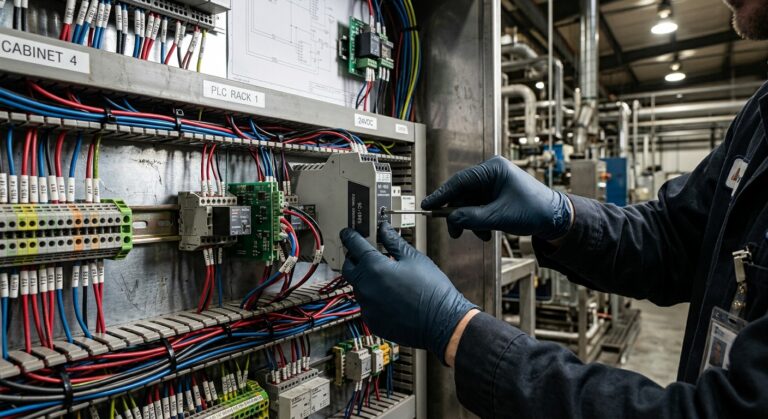
- A signal conditioner that turns the sensor’s raw output into something a logger, PLC or computer can actually use
- A data logger or telemetry system that records, timestamps and transmits that data
- A calibration and maintenance process that keeps every reading trustworthy over the life of the system
Leave out any one of those four and the system as a whole becomes unreliable, even when the sensor itself is excellent.
Why Do Industries Need End-to-End Systems Instead of Standalone Sensors?
The most common measurement failure I see isn’t a faulty sensor. It’s a good sensor connected to the wrong signal conditioner, feeding a logger with no calibration record behind it. The result is data that drifts quietly over months, readings that don’t match between shifts, or a strain gauge that looked fine in the workshop and gave nonsense numbers once it was exposed to vibration and temperature swings in the field.
In safety-critical or asset-critical applications, rail infrastructure, structural monitoring on bridges and mine sites, or environmental research where a dataset has to hold up to scrutiny, that kind of drift isn’t a minor inconvenience. It’s the difference between catching a developing fault early and finding out about it after something fails. Treating measurement as a system, rather than a shopping list of parts, is what closes that gap.
How Do You Select the Right Sensor for Your Application?
Sensor selection comes down to matching the device to three things: the parameter you need to measure, the environment it will live in, and the accuracy your decision actually requires. Questions worth answering before you pick a part number:
- What physical parameter matters — load, position, tilt, RPM, temperature, vibration, pressure or flow?
- What’s the operating environment — temperature range, moisture, dust, vibration, ingress protection rating, hazardous area classification?
- Does the application call for a contact sensor (strain gauge, LVDT, load cell) or a non-contact option (laser RPM, infrared temperature)?
- Will the sensor need to survive rotating or moving assemblies, or sit fixed on static infrastructure?
This is also where it’s worth thinking beyond a single measurement point. Rail and structural monitoring projects often need dozens of sensors reporting back to one system, which changes how you plan for cabling, power and communications from day one rather than retrofitting it later.
What Role Does Signal Conditioning Play in Measurement Accuracy?
Raw sensor output is rarely usable on its own. A strain gauge produces a tiny millivolt signal; an LVDT produces an AC signal that needs demodulating; almost every analog sensor is vulnerable to electrical noise over a long cable run. Signal conditioning is the step that fixes this. It amplifies, filters, linearises, or converts the signal to a standard industrial format such as 4–20mA or 0–10V that a PLC, data logger or indicator can actually read.
Skip this step, or use an under-specified conditioner, and you inherit every bit of electrical noise on the line. I’ve seen otherwise sound systems produce jumpy, unreliable readings purely because the signal conditioning module wasn’t matched to the sensor and the cable run between them.
How Do the Core Components Compare?
It helps to see the four building blocks side by side, along with what happens if any one of them is missing or poorly specified.
| Components | What It Does | Typical Output | Risk If Missing or Poor Quality |
|---|---|---|---|
| Sensor | Detects the physical parameter at the point of interest | Raw analog/digital signal (mV, resistance, frequency) | No data captured, or data unrelated to the real event |
| Signal Conditioner | Amplifies, filters and standardises the sensor’s raw output | 4–20mA, 0–10V, or digital protocol | Noisy, drifting or unusable readings |
| Data Logger / Telemetry | Records, timestamps and transmits the conditioned signal | Time-series data, remote dashboard, alarms | No history, no remote visibility, missed events |
| Calibration Service | Verifies and corrects accuracy against a traceable standard | Calibration certificate, correction factors | Silent drift and readings that can’t be trusted for decisions |
How Do Data Loggers Turn Raw Signals Into Usable Insight?
Once a signal is conditioned, a data logger or telemetry platform is what turns individual readings into a usable dataset. It records continuously, timestamps everything, and either stores the data locally or sends it to a dashboard, SCADA system or PLC. Remote sites benefit most from this: instead of sending someone out to read a gauge, the data comes to you.
The right choice depends on the site. A fixed installation with mains power and existing network infrastructure suits a wired logger. A remote structural monitoring point, a mobile piece of mining equipment, or a rail asset spread across kilometres of track is usually better served by wireless telemetry that can scale to dozens or hundreds of sensor points without trenching cable everywhere.
Why Is Calibration Non-Negotiable for a Reliable System?
Every sensor drifts over time, through temperature cycling, mechanical wear, vibration or simple age. Calibration is the process of checking a sensor’s output against a known, traceable standard and correcting for any deviation. Without a calibration schedule, a system can look perfectly healthy on a dashboard while quietly reporting numbers that no longer reflect reality.
This matters most in applications where the data feeds a safety or compliance decision: structural load monitoring, environmental research datasets that need to withstand peer review, or rail infrastructure where a missed fault has real consequences. Building calibration into the project from the outset, rather than treating it as an afterthought, is one of the cheapest ways to protect the value of everything else you’ve invested in the system.
How Do You Choose Between Wired and Wireless Telemetry?
Communications is where a lot of projects either save money and time, or create years of maintenance headaches. The trade-offs are fairly consistent across industries:
| Factor | Wired | Wireless Telemetry |
|---|---|---|
| Installation cost on remote or large sites | High — cabling, conduit, trenching | Lower — no cable runs between points |
| Site safety (live or hazardous equipment) | May require live access for install/maintenance | Supports safe, remote installation and monitoring |
| Scalability to many sensor points | Adding points means adding cable runs | New sensors can join the network with minimal rework |
| Best suited to | Fixed plant with existing infrastructure | Remote, mobile, rotating or hard-to-access assets |
What Does a Cohesive End-to-End Solution Look Like in Practice?
This is the part that’s easy to underestimate: a reliable measurement solution isn’t assembled from whichever parts are cheapest or most familiar. It’s engineered as one system. XTRAN, an Australian supplier of sensor-based measurement solutions, is a useful example of how this looks when it’s done as a single, integrated project rather than a pile of separate purchases.
XTRAN works across sensors, signal conditioning, wireless communications and data logging as one scope, which means the signal conditioner is matched to the sensor, the telemetry is matched to the site, and calibration is built into the ongoing relationship rather than left to the customer to chase down later.
Its XTMS wireless telemetry platform illustrates the point well. It grew out of a genuine field problem: removing maintenance personnel from live work around heavy mining equipment. It has since scaled into a platform that connects up to 100 sensors of varying types back to a single point for viewing and logging. The same underlying approach (sensor selection, conditioning, wireless transmission and a support relationship that includes calibration) applies just as well to rail asset monitoring, structural monitoring on bridges and buildings, and long-running environmental research deployments, where sensors and loggers often need to survive months in the field between site visits.
For buyers evaluating options, the useful question isn’t “which sensor is best.” It’s whether a supplier can deliver custom-engineered measurement solutions end to end, including the ongoing calibration, support and system expansion that keep a system reliable years after installation.
What Are the Practical Steps to Build Your Own Measurement Solution?
Whether you’re specifying a system yourself or briefing a supplier, the same sequence holds up across industries:
- Define the measurement objective — what decision will this data actually inform?
- Map the environment and constraints — temperature, vibration, access, hazardous areas, power availability
- Select sensors matched to the parameter, accuracy requirement and environment
- Specify signal conditioning matched to each sensor and cable run
- Choose a logging and telemetry architecture sized for the number of points and the site’s physical layout
- Build a calibration and maintenance schedule into the project from the start, not after commissioning
- Test, commission and validate the whole system against real site conditions before relying on it for decisions
How Do You Choose the Right Partner for a Measurement Solution Project?
Not every project needs to be built in-house. When you’re assessing a supplier or systems integrator, it’s worth looking past the sensor catalogue and asking:
- Do they work across the full chain — sensors, signal conditioning, telemetry and calibration — or only sell one piece of it?
- Can they point to experience across industries with similar demands, such as rail, structural monitoring, environmental research or mining?
- Do they offer ongoing calibration, support and system expansion, or does the relationship end at installation?
- Can they engineer a custom solution when an off-the-shelf sensor doesn’t fit the application?
A supplier that can answer yes to all four, the way XTRAN positions its custom measurement solutions, is generally a safer long-term bet than assembling a system from separate vendors and hoping the parts play well together.
Frequently Asked Questions
- What’s the difference between a sensor and a full measurement solution?
- How often should sensors be calibrated?
- Can wireless telemetry fully replace wired systems?
- Which industries rely on sensor-based measurement solutions?
- How long does it take to design a custom measurement system?
A sensor only detects a physical parameter. A measurement solution adds the signal conditioning, logging or telemetry, and calibration needed to turn that raw detection into trustworthy, usable data.
It depends on the sensor, the application and the consequences of drift, but most industrial and safety-critical deployments schedule calibration checks annually or more frequently, with additional checks after any major shock, impact or environmental exposure.
Not always. Wireless telemetry is generally the better fit for remote, mobile, rotating or hard-to-access assets, while wired systems can still make sense for fixed plant with existing power and network infrastructure already in place.
Rail, structural and bridge monitoring, mining, defence, utilities, and environmental research are among the heaviest users, though the same principles apply to almost any industrial process where a physical parameter needs to be measured reliably over time.
Timelines vary with the number of sensor points and the complexity of the environment, but a well-scoped project typically moves through requirements, sensor and conditioning selection, telemetry design, and on-site commissioning before it’s handed over for ongoing calibration and support.
Bringing It All Together
A reliable measurement solution is never just the sensor on the datasheet. It’s the sensor, the signal conditioning, the logging or telemetry, and the calibration discipline behind all three, engineered to work as one system for your specific environment.
If you’re scoping a sensor-based measurement project for rail, structural monitoring, environmental research or industrial use, it’s worth starting the conversation with a supplier that can own the whole chain. Get in touch with the XTRAN team to talk through your measurement challenge and what a properly integrated solution would look like for your site.

XTRAN
Phone: (03) 98745777
Email: info@xtran.com.au
Location: Unit 24 A/49 Corporate Blvd, Bayswater VIC 3153, Australia
Hours: Monday to Thursday 09:00 – 17:00 Friday 09:00 – 16:00