Monday - Thursday 9AM - 5PM | Friday 9AM - 4PM

Sensor Applications in Mining & Defence
A sensor is a small thing to bet a life on, but that’s exactly what happens underground every shift. I’ve spent years working with measurement systems for mining and defence clients here in Australia, and the question I get asked most often by site managers, procurement teams, and curious readers alike isn’t “what is a sensor”; it’s “which sensor, and why does it matter for us?” This guide answers ten of the most-searched questions about sensor applications, with a specific focus on the two industries where getting it wrong carries the highest stakes: mining and defence.
Key Takeaways
Sensors convert a physical condition pressure, gas, vibration, position into data that a system or person can act on, and that simple job now underpins mining safety, defence surveillance, and most consumer electronics.
Mining sites lean on gas detectors, vibrating wire and piezometer sensors, proximity sensors, and load/pressure transducers, increasingly tied together over wireless mesh networks (LoRaWAN, private 5G).
Military wireless sensor networks (WSNs) trace their origins to battlefield surveillance and now cover intrusion detection, target tracking, and NBC (nuclear, biological, chemical) threat monitoring.
Mine managers and senior drilling supervisors top the mining pay scale in Australia, and perhaps unexpectedly much of what justifies that pay is the ability to read and act on sensor data quickly.
1. What Are the Applications of Sensors?
At the broadest level, sensors show up anywhere a system needs to know something about the physical world before it can act. In my own work, that breaks down into a handful of recurring categories: safety monitoring (gas, fire, structural), process control (pressure, flow, temperature in a production line), asset health (vibration and thermal monitoring on rotating equipment), positioning and tracking (GPS, proximity, RFID), and environmental monitoring (weather stations, water quality, emissions).
What changes between industries isn’t the sensor physics a pressure transducer works the same way in a hydraulic ram or a mine shaft it’s the environment it has to survive and the consequence of it failing. That’s the detail generic sensor articles tend to skip, and it’s the one that actually drives specification decisions on a real project.
| Application Domain | What Sensors Do | Typical Sensor Types |
|---|---|---|
| Industrial process control | Keep a process within safe, efficient operating limits | Pressure transducers, flow meters, temperature probes |
| Mining & resources | Monitor ground stability, air quality, equipment condition | Gas detectors, piezometers, vibration sensors |
| Defence & security | Detect intrusion, track targets, monitor threats | Acoustic, seismic, infrared, magnetic sensors |
| Consumer electronics | Enable everyday convenience and safety features | Accelerometers, gyroscopes, proximity sensors |
| Healthcare | Monitor vital signs and equipment status remotely | Biosensors, wearable ECG/SpO2 sensors |
2. What Are Some Real-Life Applications of Sensors?
It’s easy to talk about sensors in the abstract, so here are examples I’d point a non-technical friend to if they asked where sensors actually show up in daily life:
- Your phone’s accelerometer rotates the screen and counts your steps.
- A car’s tyre-pressure monitoring system uses a small pressure sensor inside each wheel.
- Smoke alarms use optical or ionisation sensors to detect particles in the air.
- Automatic taps and doors use infrared proximity sensors.
- Weather stations combine temperature, humidity, wind, and barometric sensors.
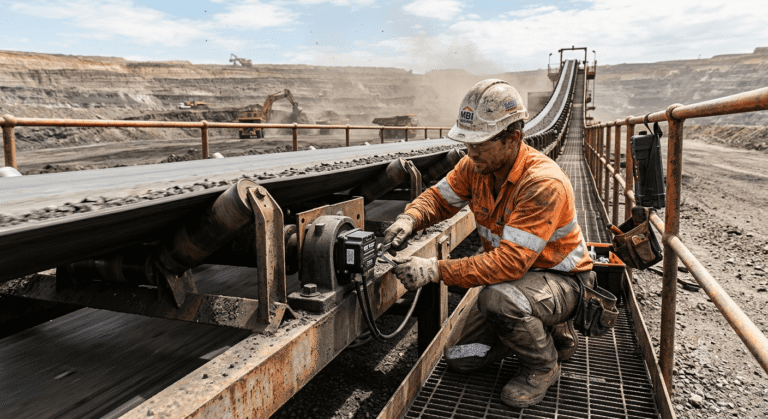
- On a mine site, a haul truck’s suspension has load sensors that feed straight into a payload management system that’s the same underlying transducer technology as the tyre-pressure sensor in your car, just built to survive 40°C dust and constant vibration.
That last example is the one I like to use with clients, because it shows the throughline: consumer and industrial sensors solve the same measurement problem, but industrial-grade sensors are engineered and priced for durability, calibration stability, and certification, not convenience.
3. What Types of Sensors Are Used in the Mining Industry?
Mining sensor selection is really about matching the sensor to the hazard. Across the projects I’ve been involved with, the sensor stack on a modern mine site typically includes:
| Sensor Type | What It Monitors | Why It Matters |
|---|---|---|
| Gas & smoke detectors | Methane, CO, H2S, oxygen levels | Prevents explosions and asphyxiation underground |
| Vibrating wire sensors/piezometers | Ground stability, pore pressure | Early warning of slope or tailings dam failure |
| Temperature & humidity sensors | Climate conditions underground | Worker comfort and equipment reliability |
| Vibration sensors | Condition of mills, crushers, conveyors | Predictive maintenance, reduces unplanned downtime |
| Proximity sensors | Presence of vehicles, people, equipment | Collision avoidance around heavy machinery |
| Load/pressure transducers | Payload, hydraulic pressure | Equipment efficiency, structural safety |
The trend I’m seeing accelerate through 2026 is wireless, battery-efficient sensor meshes think LoRaWAN or private 5G replacing the cabled sensor runs that used to dominate open-pit and underground sites. Cabling is expensive to install and vulnerable to damage from blasting and heavy equipment; a wireless mesh sidesteps both problems, at the cost of needing careful attention to battery life and network coverage planning.
4. What Are the Sensors in Mines? A Closer Look Underground
“Sensors in mines” and “sensors used in mining” sound like the same question, but on real sites they point to slightly different things. The mining industry question (above) is about the sensor catalogue across the whole operation: open pit, processing plant, haul roads. “Sensors in mines” specifically, especially underground, tends to mean the safety-critical instrumentation embedded directly in the working environment: methane and CO monitors fixed at intervals along a drive, seismic sensors watching for rockburst activity, airflow sensors confirming ventilation is doing its job, and refuge chamber environmental monitors.
Field Note
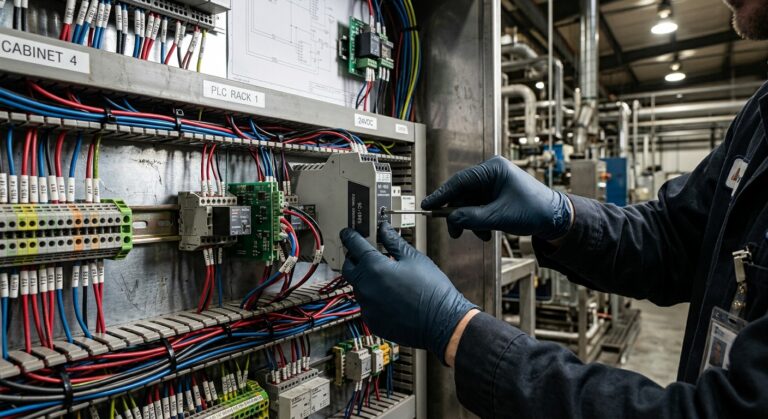
On a signal-conditioning project for an underground site, the recurring challenge wasn’t the sensor itself it was getting a clean, drift-free signal out of a harsh RF and vibration environment over long cable runs. That’s precisely the gap signal conditioning equipment is built to close: filtering noise, amplifying a weak signal, and converting it into something a logger or SCADA system can trust. A great sensor with a poor signal path is functionally a bad sensor.
This is also where remote monitoring platforms earn their keep. A rockfall or gas spike doesn’t wait for the next shift change, so the sensor network needs to push an alert in near-real time, not just log a data point for later review.
5. What Types of Sensors Are Used in Military Applications?
Defence sensor requirements share the mining industry’s obsession with reliability in harsh conditions, but add a second layer: the sensor itself often needs to be hard to detect, hard to jam, and capable of operating for extended periods without a battery change in a hostile or inaccessible location.
| Sensor Type | Function | Example Use |
|---|---|---|
| Acoustic Sensor | Detect sound signatures (gunfire, engines, footsteps) | Sniper and vehicle detection |
| Seismic sensors | Detect ground vibration form movement | Perimeter intrusion detection |
| Infrared/thermal sensors | Detect heat signatures | Night vision, target identification |
| Magnetic Sensors | Detect ferrous metal object | Vehicle and weapons detection |
| Chemical/biological sensors | Detect hazardous agents | NBC (nuclear, biological, chemical) threat monitoring |
| Image and video sensors | Visual surveillance and mapping | Reconnaissance and target tracking |
The common thread across all of these is that a single sensor rarely tells the full story it’s the network of sensors working together, correlating an acoustic event with a seismic one with a thermal signature, that produces something a commander can actually act on. Which brings us to the next question.
6. What Are the Military Applications of Wireless Sensor Networks?
Wireless sensor networks (WSNs) were, in a very real sense, born out of military need. The original motivation for developing WSNs was battlefield surveillance, and defence remains one of the most demanding proving grounds for the technology today.
- Battlefield surveillance and target tracking: dense fields of low-cost nodes relay detections through multi-hop paths back to a command post.
- Intrusion detection and perimeter security: a distributed network is far harder to defeat than a single sensor or camera.
- Monitoring friendly forces tracking the position, condition, and equipment status of troops in the field.
- Reconnaissance of terrain and opposing forces, including war-damage assessment.
- NBC threat detection and reconnaissance identifying nuclear, biological, and chemical hazards before troops are exposed.
- C4ISRT integration feeding command, control, communications, computing, information, surveillance, reconnaissance, and targeting systems with continuous sensor data.
The engineering challenge that carries directly across from defence into civilian mining and infrastructure work is energy efficiency: a sensor node deployed in a hostile or remote environment can’t be serviced on a schedule, so power budgeting, sleep cycles, and multi-hop routing to minimise transmission energy all matter enormously. It’s the same problem a remote mine-site weather station or a tailings dam piezometer network faces, just with higher stakes and an adversary actively trying to disrupt the network.
7. What Is the Highest Paid Job in Mining?
It’s a fair question for anyone landing on a sensor-technology article from a mining career search, so here’s the honest answer for the Australian market: mine managers, general managers, and operations directors at major sites lead the pay tables, with senior packages at Tier 1 operations reported to exceed $500,000 including bonuses. Just below that sit drilling supervisors and operations managers ($190k–$250k), senior mining engineers ($180k–$225k), and mining supervisors ($180k–$210k), according to Seek-sourced 2026 salary data.
What’s less obvious is the sensor connection. Every one of those top-paying roles is, in practice, a decision-making job built on top of a mountain of sensor data: geotechnical monitoring feeding the mine manager’s go/no-go calls on pit walls, payload and fatigue sensors feeding the drilling supervisor’s equipment decisions, condition-monitoring data feeding the reliability engineer’s maintenance schedule. The pay reflects the responsibility of interpreting that data correctly under pressure, not just the physical demands of the role.
8. How Do Mining and Defence Sensor Networks Actually Get Deployed?
This is the part most sensor guides skip, and it’s where the real cost and time on a project actually goes. In my experience, a deployment breaks into four stages that hold whether the customer is a mine site or a defence contractor:
- Requirements and environment assessment: what’s being measured, what range and accuracy are needed, and what the sensor has to survive (dust, vibration, temperature extremes, EMI).
- Sensor and signal-conditioning selection: matching sensor technology to the requirement, then specifying the filtering, amplification, and linearisation needed to get a clean signal out.
- Communications architecture: cabled, wireless mesh, or a hybrid, sized for the site’s coverage area and power constraints.
- Logging, viewing, and alerting: turning raw data into a dashboard or alert a supervisor can act on within seconds, not hours.
Case Study Snapshot
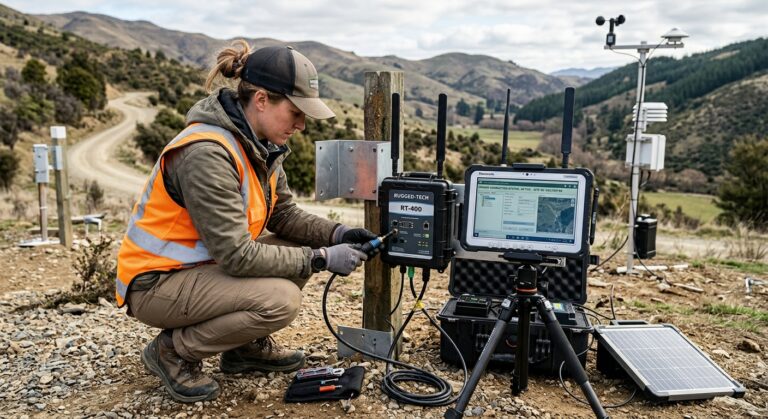
A mining client needed real-time visibility of a piece of rotating equipment operating in a remote, dusty environment where running new cable was impractical. The solution combined a ruggedised sensor with wireless telemetry back to a central logging platform, giving the site team the same real-time visibility they’d get from a hard-wired system without the installation cost or the ongoing risk of cable damage from mobile plant traffic. That’s the pattern I keep coming back to: the sensor is rarely the hard part. The system around it conditioning, transmission, and presentation is what determines whether the data actually gets used.
9. What Should You Look For When Choosing a Sensor for Harsh Environments?
If I had to compress years of sensor specification work into a short checklist for a mining or defence buyer, it would be this:
- Ingress protection (IP) rating appropriate to dust and moisture exposure.
- Operating temperature range that covers the site’s actual extremes, not just the average.
- Vibration and shock tolerance for equipment-mounted sensors.
- Certification relevant to the environment, such as intrinsic safety (IS) ratings for explosive atmospheres, for example.
- Power source and expected battery life for wireless nodes, and how that interacts with the communications protocol chosen.
- Calibration and drift characteristics over the sensor’s service life, not just at installation.
It’s tempting to over-index on accuracy specifications when comparing sensors on a datasheet. In practice, a slightly less precise sensor that survives five years in the field beats a highly precise one that fails after eight months, and the failure mode matters too: a sensor that fails silently is far more dangerous than one that fails obviously.
10. What’s Next for Sensor Technology in Mining and Defence?
Two trends are converging across both industries right now. First, wireless, battery-efficient sensor meshes are displacing cabled installations wherever terrain, cost, or mobility make cabling impractical; the same LoRaWAN and private-5G approaches showing up on mine sites echo the multi-hop, energy-constrained design principles that originated in military WSN research. Second, the sensing layer is increasingly feeding predictive and AI-assisted systems rather than simple threshold alarms, which raises the bar on data quality: a predictive model is only as good as the signal it’s trained on, which loops straight back to signal conditioning and sensor placement done the first time properly.
My own view, after watching this space for a while, is that the winners over the next few years won’t be the companies with the most sensors; most sites are already saturated with data points, but the ones that get the signal path, communications, and presentation layers right so the data is actually trustworthy and actionable when it matters.
Related Reading & Internal Links
For readers who want to go deeper on any of the systems mentioned in this guide:
XTMS Sensor-Based Wireless Telemetry Solutions