Monday - Thursday 9AM - 5PM | Friday 9AM - 4PM
How XTRAN’s XTMS System Solves the Toughest Industrial Monitoring Challenges
Whether you work in mining, construction, agriculture, or heavy industry, one reality is universal: taking measurements on live, operational equipment is dangerous, inaccurate, and time-consuming. Workers are routinely placed near moving machinery, hydraulic lines under pressure, and heavy vehicles just to capture data that guides critical maintenance decisions. The risks are real, and the costs of getting it wrong are enormous.
This is precisely the problem that XTRAN, a division of Applied Measurement Australia, set out to solve. Their answer is the XTRAN Telemetry Measurement System (XTMS): a ruggedised, wireless, multi-sensor platform purpose-built for Australia’s most demanding environments. In this post, we break down the key challenges facing industrial maintenance teams and show exactly how the XTMS system eliminates them, one by one.
XTMS enables wireless sensor measurement up to 800m, connects up to 100 sensors simultaneously, eliminates the need for live work near dangerous equipment, and has been shown to reduce site risk by over 40%. It is fully customisable for mining, construction, agriculture, and industrial applications across Australia.
The Problem: Why Industrial Measurement Is Dangerous and Inefficient
For maintenance engineers and site managers, collecting accurate equipment data has long meant sending personnel into harm’s way. The traditional approach manual gauges, handheld instruments, and wired measurement rigs require direct access to equipment that is often still live, hot, pressurised, or moving.
1. The Live Work Safety Crisis in Australian Industry
In the Australian mining sector, the practice of taking measurements while equipment is operational or immediately after is categorised as “live work.” The risks include crush injuries, hydraulic fluid injection, burns from hot surfaces, and falls from height. Industry regulators and major mining operators have made Elimination of Live Work (ELW) a core safety priority, but without the right technology, workarounds remain dangerous or impractical.
- Maintenance staff forced to work in proximity to pressurised hydraulics
- Manual dial gauges require physical contact with rotating or hot components
- Confined spaces and underground environments make wired measurement unreliable
- Human error in manual data entry increases the risk of missed wear indicators
Customers using XTRAN’s XTMS system have reported reducing their site risk by more than 40% a significant improvement that directly protects maintenance personnel and reduces liability.
2. Accuracy Problems with Traditional Measurement Methods
Manual measurement is subject to significant variability. Different technicians reading the same gauge can produce different results. Vibration, ambient temperature, and restricted sight lines all compound the problem. When maintenance decisions rest on inaccurate data, the consequences include premature component replacement, missed failure events, and unplanned downtime.
- Gauge parallax error from awkward viewing angles
- Vibration-induced fluctuations in handheld readings
- No historical trending, each measurement exists in isolation
- Inconsistent recording practices across shifts and operators
3. Operational Inefficiency and Documentation Burden
Beyond safety and accuracy, the manual measurement workflow creates a heavy administrative burden. Technicians spend considerable time walking to and from measurement points, manually recording readings, and later transferring data into maintenance management systems. This slows maintenance cycles, delays decision-making, and creates opportunities for transcription errors.
The Solution: XTRAN’s XTMS Wireless Telemetry Measurement System
The XTRAN Telemetry Measurement System (XTMS) was originally developed in direct collaboration with one of Australia’s largest mining companies. The brief was clear: enable accurate measurement of critical parameters on heavy mining equipment without placing workers in danger. What emerged was a flexible, scalable platform that has since proven its value across multiple industries and application types.
At its core, XTMS is a wireless, multi-sensor data acquisition and telemetry system. It connects up to 100 sensors of any type to a single rugged tablet, transmitting real-time data over a proprietary 2.4GHz wireless protocol, no Wi-Fi routers, no third-party hardware, no single points of failure.
Traditional vs XTMS Measurement: A Direct Comparison
| Challenge | Traditional Approach | XTMS Solution |
|---|---|---|
| Worker proximity to live equipment | Required operators must be beside the machinery | Eliminated measure from up to 800m away |
| Number of simultaneous sensors | One at a time (manual) | Up to 100 sensors simultaneously |
| Data accuracy | Variable human error and reading conditions | Consistent digital output, logged automatically |
| Historical trending | Manual records, spreadsheets | Automatic timestamped data logging and reporting |
| Equipment compatibility | Specific gauges per application | Any sensor type via custom integration |
| Operating environment | Limited by wired connections | Rugged wireless, works underground and in metal-dense environments |
How XTMS Directly Addresses Each Challenge
Solving Problem 1: Eliminating Live Work and Protecting Your People
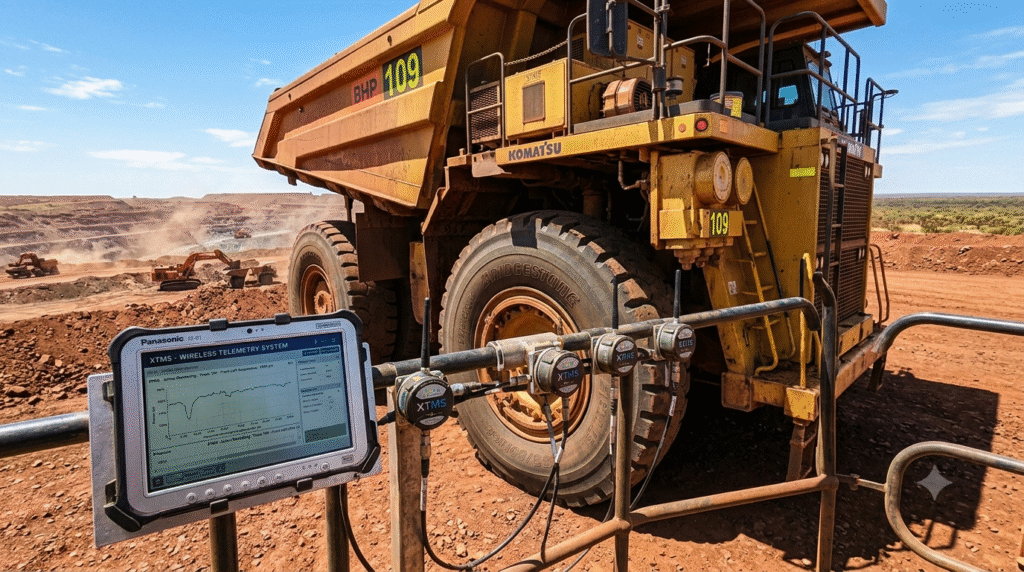
The most immediate impact of XTMS is removing the need for maintenance personnel to be close to equipment during measurement. Using 2.4GHz wireless telemetry with a range of up to 800 metres line-of-sight (and further with a repeater), XTMS allows readings to be taken from a safe, remote location, even from outside a maintenance shed, or from the surface in an underground mining context.
Sensors are attached to the equipment’s hydraulic lines, suspension linkages, and rotating components, and data flows wirelessly to the XTMS rugged tablet. The maintenance technician reads the data in real time without ever needing to approach the live machine.
- Hydraulic and air pressure readings: taken remotely, from up to 800m
- Bearing and bush wear measurements: magnetic-mount sensors attach in seconds
- Temperature and RPM (Tacho) readings: non-contact sensors capture data safely
- No Wi-Fi router dependency: point-to-point protocol eliminates signal dropout risk
Explore the full XTMS sensor range, including pressure, linear position, temperature, and RPM sensors, to see how each is designed for safe remote deployment.
Solving Problem 2: Delivering Consistent, Accurate Measurement Data
Unlike manual gauges, XTMS sensors output consistent digital signals that are unaffected by the technician’s viewing angle, ambient lighting, or reading conditions. The system supports simultaneous multi-sensor monitoring up to 100 sensors at once, enabling a complete picture of equipment health in a single pass.
Sensor Types Available in XTMS
- Hydraulic/Air Pressure Sensors – 5,000 psi and 10,000 psi standard ranges
- Ball Tip and Roller Tip Linear Position Sensors – for bush/bearing wear checks on suspension components
- Rod End Linear Position Sensors – for measuring between two surfaces in tight spaces
- Non-Contact Temperature Sensors – up to 1,030°C at up to 500mm distance
- Contact Temperature Sensors – surface temperature up to 125°C
- Standard and High-Temp Laser RPM (Tacho) Sensors – for fan blades and rotating assemblies
All sensors are integrated with wireless transmitters and feature powerful 90kg-rated magnetic mounts for rapid, secure positioning even in high-vibration environments.
Solving Problem 3: Automating Data Logging and Reporting
XTMS eliminates the manual transcription workflow. The system’s viewing and logging platform runs on a military-specification rugged tablet with a CNC-machined aluminium chassis, toughened glass, a resistive touchscreen that works even when wet, and captures all sensor readings automatically with timestamps.
Custom reports can be generated that collate measurement data, vehicle ID, operator ID, sensor ID, measurement location, statistical summaries (mean, max, min), and trend graphs, everything needed for a maintenance decision or compliance record.
What Custom Reports Include
- Timestamp and shift data
- Vehicle and operator identification
- Sensor readings per measurement location
- Statistical summaries: average, max, min, median
- Graphical trend data across time, shift, operator, and equipment
XTMS Platform Benefit
By automating data capture and reporting, XTMS reduces manual documentation time, eliminates transcription errors, and builds a historical database of wear profiles that enables predictive maintenance decisions before a failure event occurs.
XTMS Across Industries: Built for Australia’s Harshest Environments
One of XTMS’s greatest strengths is its versatility. Explore how the platform is deployed across XTRAN’s focus industries:
Mining
XTMS was born in the mining industry and remains its flagship application. From the elimination of Live Work on haul trucks and dozers to tunnel monitoring, conveyor belt tensioning, and underground sensor networks, XTMS handles the full breadth of mining measurement needs. The 2.4GHz protocol is proven to operate in underground tunnels and around dense metal equipment.
Construction
On active construction sites, XTMS can monitor crane load cells, boom angles, hydraulic pressures on heavy plant, and structural stability sensors on scaffolding and formwork. The ELW capability is equally relevant for construction equipment maintenance as it is in mining.
Agriculture
For heavy farm equipment, XTMS enables monitoring of hydraulic systems, steering linkage wear, and hitch condition, keeping maintenance crews out of harm’s way while providing the data needed to maximise machine uptime.
Industrial
Across manufacturing and process industries, XTRAN’s custom integration capability allows XTMS sensor data feeds to connect directly into operational management systems via protocols including Modbus, PROFINET, EtherCAT, CAN, IoT, and LoRaWAN.
Custom Solutions: When Standard XTMS Isn’t Enough
XTRAN’s engineering capability extends well beyond the standard XTMS kit. The custom solutions platform allows the team to rapidly develop and integrate alternative sensors, custom visualisations, and bespoke data integrations for specific applications.
Custom Sensors
If a standard sensor doesn’t meet your accuracy, size, connector, or application requirements, XTRAN can design a custom sensor solution integrated directly into the XTMS platform.
Custom Visualisation
Need to see data as a graph rather than a number? Want a digital twin view of your equipment layout? XTRAN can develop custom visualisations tailored to your application and the data you actually need to act on.
Custom Data Integration
Sensor data feeds can be integrated directly into operational management systems, building granular wear-profile histories for each component on each asset. This enables far more precise decisions about when to schedule overhauls and when failure risk is elevated, moving from reactive to predictive maintenance.
To discuss a custom measurement challenge, contact the XTRAN team or explore the signal conditioning solutions available for complex sensor output requirements.


