Monday - Thursday 9AM - 5PM | Friday 9AM - 4PM

How to Evaluate Whether a Custom Measurement Solution Is Right for Your Application
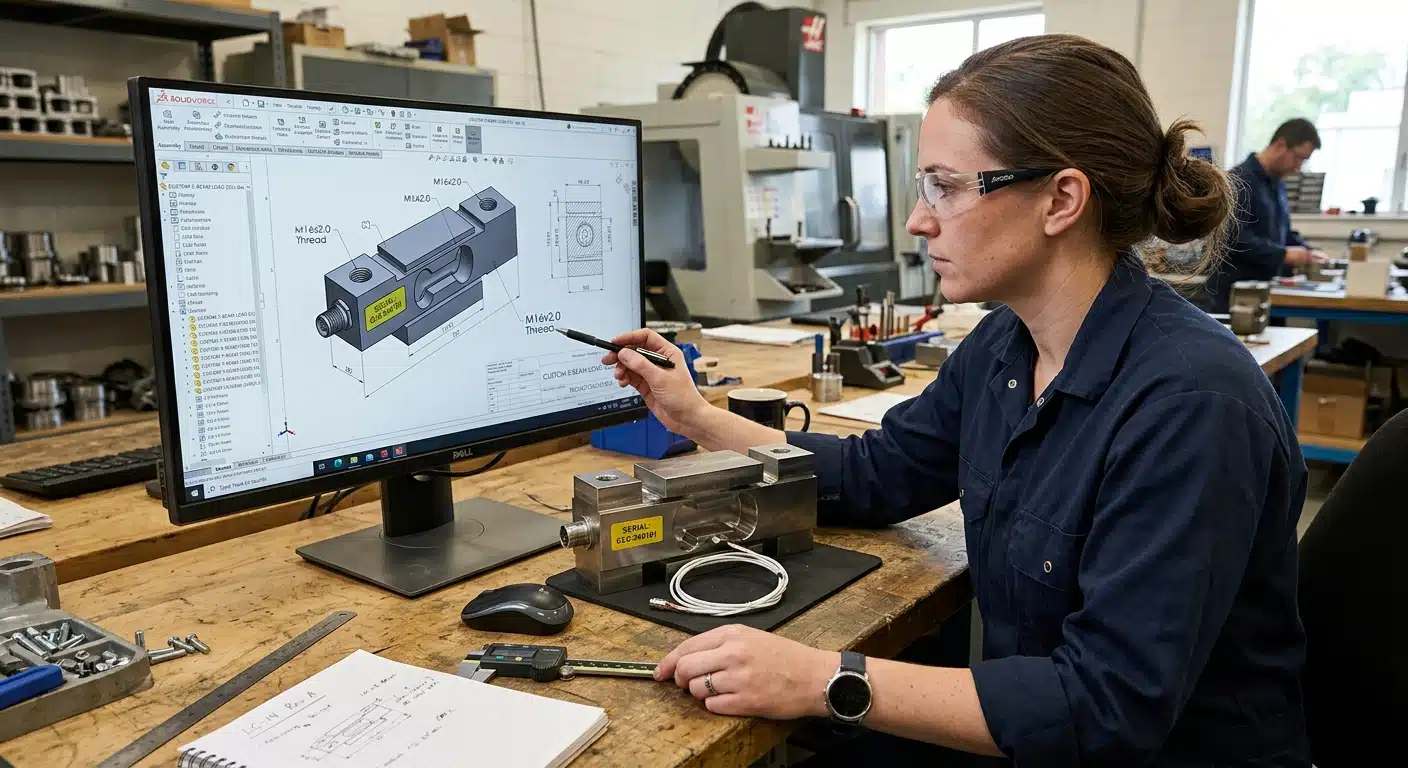
A client once sent me a drawing of a bracket with a load path I genuinely hadn’t seen before — combined bending and torsion, off-axis, in a housing with about 12mm of clearance either side. Every standard load cell in the catalogue was either the wrong shape, the wrong range, or would have needed a mounting adaptor that changed the load path anyway. That’s usually the moment a procurement manager or design engineer starts asking whether they need something custom-built, and it’s a fair question to ask early rather than after a standard sensor has already failed in service.
“Custom” gets thrown around loosely in this industry. Sometimes it means a re-ranged version of an existing product. Sometimes it means a sensor designed from a blank sheet for one application and never sold again. Knowing which one you actually need, before you request a quote, saves weeks of back-and-forth and a fair bit of budget.
This piece walks through the questions worth answering before you commit to a custom build: your load path, your environment, your space constraints, and how the sensor needs to talk to the rest of your system. It’s written for engineers and procurement teams doing that research before a spec goes out to quote.
What Actually Counts as a “Custom” Measurement Solution?
Before evaluating whether you need one, it helps to separate three tiers that all get called “custom” in casual conversation.
An off-the-shelf sensor is exactly what it sounds like: a catalogue part in a standard range, housing, and output. A modified-standard sensor keeps most of an existing design but changes one or two variables a different capacity, an extended cable, an alternate connector, a different housing material for a mildly corrosive environment. A fully custom sensor starts from your load path, your envelope, and your environment, and is engineered from there. Most projects that feel like they need “custom” actually land in the modified-standard tier once someone asks the right questions, which is worth knowing before you assume a 12-week bespoke build is your only option.
What Are You Actually Trying to Measure?
It sounds obvious, but this is where a lot of over-specified custom projects start. Before you get to load paths and environments, get clear on the failure mode or the parameter you actually need visibility on. Are you protecting against overload? Verifying a design assumption? Feeding a control loop? Each of those has a different tolerance for accuracy, response time, and mounting compromise, and that tolerance changes whether a standard part is genuinely unsuitable or just slightly inconvenient.
I’ve seen procurement go to tender for a fully custom load cell when a modified-standard part with a longer cable and a different output would have done the job for a fraction of the cost and lead time. A clear statement of what you’re protecting against, or what decision the data feeds into, makes that distinction obvious early.
Do You Have a Unique or Combined Load Path?
This is the biggest driver of genuine custom work. A standard load cell is designed and strain-gauged for one dominant loading direction pure tension, pure compression, or pure shear. The moment your application introduces bending, torsion, off-axis loading, or a combination of these, a standard part will either under-read, drift, or fail well before its rated capacity.
Agricultural equipment, custom test rigs, and structural monitoring points are common offenders here, because the load rarely arrives cleanly in-line with the sensor. If your load path doesn’t match a catalogue diagram, that’s a strong early signal you’re heading toward a modified or fully custom design, not a sourcing problem you’ll solve by shopping around for a bigger safety factor.
Will Environmental Extremes Rule Out a Standard Sensor?
Load capacity is only half the environmental question. Temperature extremes, submersion or wash-down requirements, chemical exposure, and hazardous area classification all push a project toward custom housings, seals, and cabling well before the strain gauge configuration is even discussed.
A sensor rated for a hazardous atmosphere, for instance, needs specific certification and construction that most standard catalogue parts simply don’t carry. The same goes for anything operating well outside the “industrial standard” range of roughly –20°C to 80°C, or exposed to washdown chemicals that will attack a standard housing’s seals over time. If your environment sits outside those boundaries, custom construction is usually the only path to a sensor that survives its warranty period, let alone its service life.
Are You Working Within Tight Form Factor or Weight Constraints?
Retrofitting a sensor into existing equipment is one of the most common reasons a project goes custom. Legacy machinery, mobile equipment, and weight-sensitive assemblies often leave no room for a standard housing, and adapting the surrounding structure to fit the sensor, rather than the other way around, is usually the more expensive option once you account for downtime and re-certification.
A custom low-profile or embedded design can solve this without touching the host structure at all, but it does mean the sensor’s electronics and strain gauge layout need to be designed around your envelope from the outset rather than squeezed in after the fact.
How Complex Is the Integration Into Your Existing System?
A sensor that measures accurately but doesn’t talk to the rest of your system cleanly just creates a second problem. Think through the signal conditioning your existing DAQ, PLC, or SCADA system expects, the connector and cable length your installation allows, and the calibration traceability your quality system requires.
This is where a lot of “we’ll sort it out on site” integrations go wrong. If your control system expects a 4-20mA loop and the sensor you’ve sourced outputs mV/V, you’re adding a signal conditioner and another point of failure into the system after the fact. Getting the output, excitation, and calibration certificate format agreed before the build starts is far cheaper than reworking it in the field.
Standard, Modified-Standard, or Fully Custom: Which Fits Your Project?
Once you’ve worked through load path, environment, form factor, and integration, the right tier usually becomes obvious. Here’s roughly how the three compare on the things procurement teams care about most.
| Approach | Typical Lead Time | Relative Cost | Design Flexibility | Best Fit |
|---|---|---|---|---|
| Off-the-shelf | Days to Weeks | Low | None | Standard load paths, common ranges, no unusual environment |
| Modified-Standard | 2-6 weeks | Low-moderate | Limited (range, output, housing, cable) | Close to standard but needs a tweak: re-range, re-house, extended cable, alternate connector |
| Fully Custom | 6-16+ weeks | Moderate-High | Complete | Unique load path, extreme environment, tight form factor, or high-volume OEM integration |
If you’re still unsure which column your project sits in, that’s exactly the conversation a good strain gauge and load cell design team should be able to have with you before any quote is issued, not after.
What Does Going Custom Actually Cost, in Time and Money?
Custom projects carry non-recurring engineering costs on top of the unit price, and that’s the part procurement teams sometimes underestimate. Design time, prototype iteration, and first-article calibration all add cost before a single production unit ships. Lead times of six to sixteen weeks aren’t unusual for a fully custom sensor, longer again if the environment demands specialist certification.
The comparison that actually matters isn’t custom cost versus standard sensor cost — it’s custom cost versus the cost of a standard sensor failing in an application it was never designed for. Downtime, re-work, and a repeat purchase usually cost more than the NRE would have.
What Should You Look for in a Custom Measurement Partner?
The single biggest risk in a custom project isn’t the engineering it’s the handoffs. A design house that doesn’t manufacture, a manufacturer that doesn’t calibrate, and a calibration lab that doesn’t understand the original design intent all introduce a place for your specification to get diluted.
An end-to-end partner with over 30 years of load cell manufacturing experience, an in-house strain gauging team, and a NATA-accredited calibration laboratory keeps that whole chain under one roof. That’s the model we operate at AMA the same team that scopes the load path with you is the one strain-gauging the part and issuing the calibration certificate, so nothing gets lost in translation between design intent and finished product.
It’s the same philosophy behind our XTRAN custom measurement solutions work: sensors, signal conditioning, communications, and logging engineered together as one system rather than assembled from parts that were never designed to work as a set.
What Does a Custom Measurement Project Look Like, Step by Step?
In practice, a custom build with us tends to follow the same sequence regardless of application: you outline the load path, environment, and integration requirements; our technical team reviews it against material, sealing, and strain gauge options and flags anything that would push cost or lead time; we agree a design and, where warranted, build a prototype for sign-off; the finished sensor is calibrated and certified before it ships; and we stay involved for support, recalibration, or a second production run down the track.
Our XTRAN Telemetry Measurement System case study is a practical example of that process in action: the base system was engineered to accept different sensor types pressure, RPM, linear position, temperature, vibration, force in whatever combination a client’s application needed, without redesigning the platform from scratch for each new job. That’s the difference between a one-off custom part and a custom-configurable system, and it’s worth asking a prospective partner which one they’re actually offering you.

Frequently Asked Questions
- Is there a minimum order quantity for a custom sensor?
- How long does a custom measurement project take from enquiry to delivery?
- Does a custom sensor come with a calibration certificate?
- Can an existing standard sensor be modified instead of designing from scratch?
- What information should I have ready before requesting a custom measurement solution?
It depends on the design complexity, but many custom and modified-standard projects can start from a single unit for prototyping, scaling to production volumes once the design is validated. Tooling-heavy fully custom designs may carry a higher minimum to justify the upfront engineering cost.
A modified-standard sensor can often be delivered in two to six weeks. A fully custom design, including prototyping and first-article calibration, typically runs six to sixteen weeks depending on certification requirements and material lead times.
Yes, a properly delivered custom sensor should ship with a calibration certificate, and where relevant, NATA-accredited or traceable calibration documentation matching your quality system’s requirements.
Often, yes. Many applications that seem to need a fully custom build are actually solved by modifying an existing design: re-ranging it, changing the housing material, extending the cable, or altering the output. It’s always worth raising your full requirement before assuming a ground-up design is necessary.
The load path (including any bending, torsion, or off-axis components), the environmental conditions, your space and weight envelope, the required output and connector type, and the calibration standard your organisation needs. The more of this you can supply upfront, the faster and more accurate the resulting quote will be.
Final Thoughts
Most applications don’t need a fully custom sensor, but the ones that do are usually easy to spot once you ask the right questions: an unusual load path, an environment outside standard tolerances, a form factor that won’t accommodate an off-the-shelf housing, or an integration requirement a catalogue part can’t meet. Working through those questions before you request a quote is what separates a smooth custom project from a six-month back-and-forth.
If you’re weighing up whether your application needs a custom measurement solution, get in touch with our team to talk through your load path and requirements before you commit to a design.
XTRAN
Phone: (03) 98745777
Email: info@xtran.com.au
Location: Unit 24 A/49 Corporate Blvd, Bayswater VIC 3153, Australia
Hours: Monday to Thursday 09:00 – 17:00 Friday 09:00 – 16:00